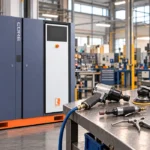
Reliable compressed air helps keep paper packaging production moving. From pneumatic positioning and machine controls to carton forming and downstream handling, a consistent air supply supports coordinated equipment operation.
For paper packaging plants in Malaysia, compressor selection also needs to account for hot, humid operating conditions, paper dust and changing production demand. This application case explains how a UMW Air system can address these requirements in a small to medium-sized carton converting facility.
Customer Background
The example facility processes purchased corrugated sheets into shipping cartons and general-purpose outer packaging. Its operations include printing, slotting or die-cutting, folding and gluing, and final packing.
The plant runs two shifts, with equipment use varying by order size and production schedule. Several machines may draw compressed air simultaneously during busy periods, while demand falls during changeovers and adjustments.
| Item | Illustrative Project Conditions |
|---|---|
| Industry | Corrugated box and paper packaging manufacturing |
| Production scope | Converting purchased corrugated sheets; paper manufacturing excluded |
| Operating schedule | Approximately 16 hours per day |
| Main air users | Pneumatic cylinders, valves, positioning mechanisms and downstream handling devices |
| Required equipment inlet pressure | Assumed 6–7 bar, subject to equipment specifications |
| Peak simultaneous air demand | Assumed 2.8 m³/min, expressed as free air delivery equivalent |
| Demand pattern | Fluctuating between simultaneous production and changeover periods |
| Main priorities | Stable pressure, moisture removal, variable-load operation and convenient maintenance |
These conditions illustrate the selection process. Actual requirements depend on the installed equipment and its operating cycle.
Where Compressed Air Is Used
Compressed air primarily powers pneumatic actuators and control mechanisms within the production equipment. The exact air users depend on machine design and automation level. Packaging applications commonly include positioning, carton forming, handling and sorting.
| Production Stage | Typical Compressed Air Uses | Main Supply Requirement |
|---|---|---|
| Printing and sheet handling | Pneumatic positioning, clamping and adjustment mechanisms | Consistent pressure for reliable movement |
| Slotting and die-cutting | Pneumatic clamping, positioning and auxiliary devices | Sufficient pressure during simultaneous actuation |
| Folding and gluing | Pneumatic actuators, auxiliary pressing and rejection mechanisms | Reliable operation throughout the production cycle |
| Final packing and handling | Pneumatically equipped strapping, pushing and diverting systems | Capacity to handle intermittent demand peaks |
Vacuum systems and low-pressure blowers used for sheet handling should be assessed separately. Equipment supplied by an independent vacuum pump or blower should not automatically be included in the screw compressor’s air demand.
Three Key Compressed Air Challenges
1. Pressure Fluctuations During Simultaneous Operation
Compressor discharge pressure alone does not show whether every production machine receives adequate pressure.
Dryers, filters, piping and fittings all introduce pressure losses. When several machines operate simultaneously, equipment at the far end of the distribution network may experience insufficient inlet pressure.
The system should therefore be designed around the minimum pressure required at the equipment inlet. Compressor settings must account for treatment and distribution losses, while receiver capacity should be checked against short demand peaks and allowable pressure fluctuations.
2. Moisture Control in Humid Conditions
Moisture in compressed air can contribute to corrosion, affect downstream equipment and increase contamination risks. Dryer selection should start with the required pressure dew point and account for actual operating conditions.
For this example, a refrigerated dryer provides moisture removal for general pneumatic equipment, supported by automatic condensate drains.
Dryer capacity must be checked at the expected inlet temperature, ambient temperature and operating pressure. Matching its nominal flow rating to the compressor’s rated output without applying the relevant correction factors may leave the system undersized.
Where air contacts paper surfaces or the inside of packaging, particle, moisture and oil requirements should be assessed separately.
3. Changing Demand Between Production Runs
Carton dimensions, batch sizes and processing steps vary between orders. As a result, the compressor may spend considerable time operating below full demand.
Within its operating range, a variable-speed compressor can adjust output to follow these changes. Actual energy savings depend on the load profile, pressure settings, leakage and the existing supply arrangement, so performance should be assessed using operating data.
Proposed Solution: UMW Air Prime 22 kW Integrated Screw Air Compressor
For the illustrative demand profile, a UMW Air Prime 22 kW compressor with an 8 bar configuration is a preliminary selection candidate. The package combines compression, air storage, refrigerated drying and filtration for the plant’s general pneumatic equipment.
Using the assumed peak demand and a preliminary 15% allowance:
Initial required capacity = 2.8 × 1.15 = 3.22 m³/min
This allowance is used only for the example calculation. Final sizing should account for simultaneous operation, leakage, planned expansion and site conditions.
| Component | Proposed Configuration and Purpose |
|---|---|
| Compressor | Prime 22 kW permanent magnet variable-speed screw compressor |
| Pressure configuration | 8 bar configuration, with operating settings determined by equipment requirements and system pressure losses |
| Reference air delivery | Approximately 3.76 m³/min; confirm against the selected model’s rated performance at the required pressure |
| Air receiver | Integrated 340 L receiver; assess additional storage if short demand peaks are significant |
| Air dryer | Refrigerated dryer sized for actual temperature, pressure and dew point requirements |
| Filtration | Three-stage filtration selected to meet the required air quality, with filter pressure-drop monitoring |
| Condensate drainage | Suitable automatic drains at air storage and treatment points |
| Control | Output adjustment to follow production demand, with operating-status monitoring |
The integrated Prime configuration suits facilities seeking a compact installation with fewer on-site connections and centralized maintenance access.
If additional production lines substantially increase continuous demand, the capacity calculation should be revisited to determine whether a Core Series split-type system is more suitable.
Installation and Maintenance for a Paper Packaging Environment
Paper dust can accumulate on compressor intake filters and cooler surfaces. The compressor should be installed in a well-ventilated area with relatively low dust exposure, away from die-cutting waste collection points.
Adequate space should also be reserved for cooling airflow and maintenance access.
Recommended operating practices include:
- Check pressure at the equipment: Record inlet pressure at the most distant machine while several machines are running.
- Monitor drying and drainage: Inspect dryer operation and automatic drains regularly to identify moisture problems early.
- Adjust cleaning intervals to dust conditions: Base filter and cooler inspections on actual contamination levels.
- Control leaks and idle consumption: Inspect hoses, fittings and valves, and isolate unused production branches.
- Plan for maintenance downtime: Where production cannot stop during compressor servicing, assess backup equipment or a temporary supply connection.
For food-contact packaging, confirm the customer’s air quality and verification requirements separately. An oil-injected screw compressor fitted with conventional filters should not automatically be described as supplying oil-free air.
Performance Objectives and Verification
The proposed system aims to support peak production demand, maintain appropriate air dryness and respond to changing loads. These objectives should be verified after installation.
| Objective | Suggested Verification Method |
|---|---|
| Maintain pressure during peak demand | Record minimum equipment inlet pressure during simultaneous operation |
| Reduce the risk of liquid water in the network | Check pressure dew point, drain operation and downstream signs of water |
| Respond to changing air demand | Record compressor loading across shifts and production schedules |
| Evaluate energy performance | Compare electricity use under similar output and operating conditions |
| Improve maintenance planning | Track filter pressure drop, cleaning intervals and equipment alarms |
A Compressed Air System Matched to Your Packaging Plant
Selecting an air compressor for a corrugated box or paper packaging plant requires a clear understanding of pressure, simultaneous demand, air quality and operating hours.
The compressor, receiver, dryer, filters and distribution network must work together to meet those requirements.
UMW Air can help assess suitable equipment and air treatment configurations based on your machine list, operating parameters and installation conditions. Share your equipment pressure requirements, air consumption and daily operating schedule to begin an initial selection.