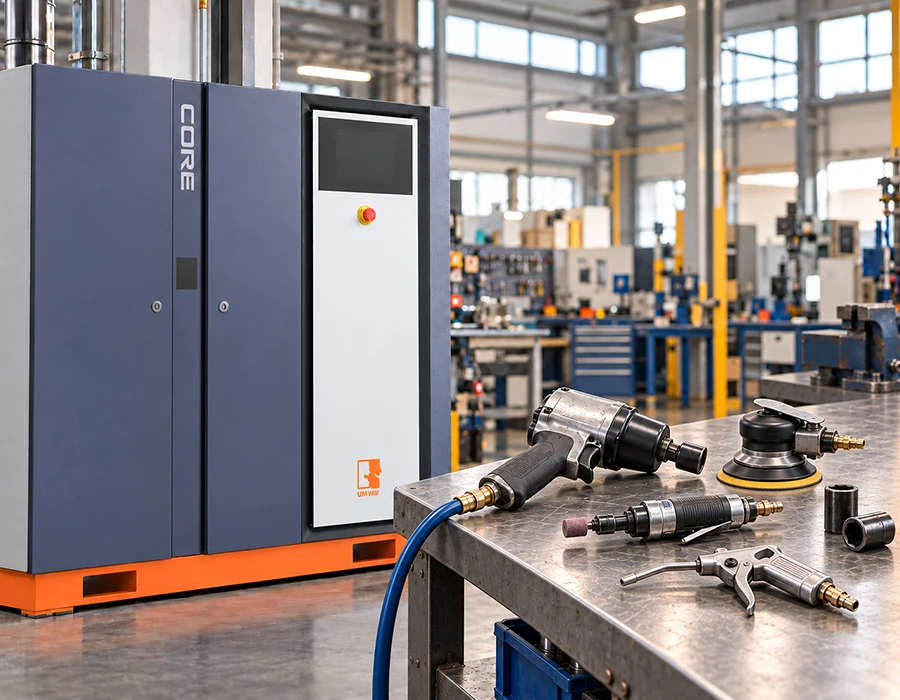
Compressed air supports everyday production across industrial workshops. It powers assembly tools, operates pneumatic clamps, and drives cylinders that position and transfer components. Choosing the right air compressor for pneumatic tools helps maintain a reliable air supply when multiple workstations operate simultaneously and demand fluctuates.
The UMW Air Core screw air compressor offers a 30–110 kW platform for medium and large workshops. Its split-system design allows users to independently select the compressor, air receiver, dryer, and filters, thereby enabling businesses to configure the system according to their production needs.
Where Compressed Air Supports Workshop Production
A workshop may contain many different pneumatic devices, each with its own consumption pattern. Some tools run intermittently, while others require sustained airflow throughout a production cycle.
| Pneumatic equipment | Typical workshop application | Main supply consideration |
|---|---|---|
| Pneumatic screwdrivers and impact tools | Fastening during equipment and component assembly | Sufficient airflow when several operators work simultaneously |
| Pneumatic grinders and sanders | Deburring and surface preparation | Capacity matched to sustained tool operation |
| Pneumatic clamps and fixtures | Holding components during machining or assembly | Consistent pressure during the holding cycle |
| Air cylinders and control valves | Positioning, feeding, sorting, and transferring parts | Suitable air quality and dependable pressure |
| Pneumatic maintenance tools | Equipment servicing and workshop repairs | Allowance for intermittent additional demand |
These applications should be assessed as a connected system. Adding a new workstation changes the demand on the compressor, treatment equipment, and distribution piping—not just the air connection at that workstation.
Match Air Supply to Actual Production Demand
Selecting an air compressor for pneumatic tools starts with understanding how the workshop operates.
A list of installed tools provides a useful starting point, but their maximum consumption figures alone do not describe the workshop’s demand. Operating duration, simultaneous use, and short consumption peaks all matter.
Record the air consumption and required inlet pressure of each device. Then identify which machines operate together during the busiest production periods. Where possible, measure the workshop’s airflow and pressure over a representative production cycle.
Pressure should also be checked at the equipment while it is operating. A satisfactory reading at the compressor does not establish that a distant tool receives enough pressure. Filters, hoses, couplings, and distribution piping can all contribute to pressure loss.

For example, an assembly workshop might operate fastening tools intermittently while a finishing station runs an air-powered sander for longer periods. Selecting around tool count alone would overlook the difference between these consumption patterns.
Why the Core Series Fits a Central Workshop Air System
The Core combines configurable system components with operating visibility for production and maintenance teams.
| Core feature | Relevance to workshop operation |
|---|---|
| Separate compressor, receiver, dryer, and filters | Allows storage and air treatment to be matched to the workshop |
| Permanent-magnet motor with demand-responsive speed control | Adjusts compressor output as air demand changes |
| PLC control and 7-inch HMI | Displays pressure, temperature, operating status, alarms, and maintenance information |
| Oil temperature management | Helps manage operating temperature and reduce condensation risk within the compressor |
| Design for continuous industrial operation | Supports workshops with long working hours or multiple shifts |
The final configuration should match the selected model and operating conditions.
Specify the Air Quality Requirements for the Equipment
Air quality deserves the same attention as airflow and pressure. Moisture, particles, and lubricant contamination can affect equipment reliability and increase maintenance requirements.
Start with the requirements specified by the pneumatic equipment manufacturer. These determine the appropriate dryer, filtration arrangement, and condensate drainage system.
Different workshop areas may need different treatment levels. A general assembly tool and a contamination-sensitive production process should not automatically receive the same specification. Where practical, dedicated treatment can serve equipment with more demanding requirements.
Filters also require maintenance. As filter elements become fouled, pressure loss increases, potentially affecting downstream equipment. Regular inspection of filters and drains helps maintain the intended supply quality.
For Core systems, UMW Air lists a pressure dew point of approximately +3°C when paired with a suitable refrigerated dryer. Actual performance depends on dryer selection and operating conditions.
Plan the System Around the Workshop Layout
A useful layout review starts with three questions:
- Which workstations are farthest from the compressor?
- Which equipment creates the largest or most frequent demand peaks?
- Where is additional production equipment likely to be installed?
These answers help guide the distribution layout and identify where pressure measurements will be most useful.
Air storage and compressor controls should be considered together with the demand profile. If a workshop experiences brief consumption peaks, the system assessment should examine whether storage can support those events. If demand remains high for extended periods, the compressor must provide the required sustained output.
Leave practical access for servicing the compressor, changing filter elements, and inspecting drains. Expansion planning should also include space and connection points for future equipment.
Information to Prepare Before Selecting a Core Compressor
To make the selection process more useful, prepare a short workshop air-demand brief:
- Types and quantities of pneumatic equipment.
- Manufacturer-specified airflow and inlet pressure.
- Expected simultaneous operation and duty cycles.
- Daily operating hours and shift arrangements.
- Required air quality at each application.
- Existing pressure measurements and known supply problems.
- Available electrical supply, installation space, and expansion plans.
This information helps connect the compressor specification to real production needs. It also gives the supplier a clearer basis for recommending receiver capacity, drying equipment, and filtration.
Overview of Technical Application Parameters
| Specification | Core Series |
|---|---|
| Motor Power Range | 30-110kW |
| Working Pressure | 6–25 bar |
| Air Delivery | 2.6-21.07 m³/min |
| Cooling Method | Air Cooled |
| Voltage / Phase | 380 V / Three Phase |
| Ambient Temperature | ≤45°C |
| Noise Level | 76–78; unit and test conditions to be confirmed |
| Overall Dimensions (L × W × H) | From 1650 × 1250 × 1460 to 2450 × 1800 × 1800 mm |
Discuss Your Workshop Air Requirements with UMW Air
Planning a central air supply for assembly tools, pneumatic fixtures, or automated workshop equipment? Explore the Core series screw air compressor and share your equipment list, required pressure, airflow demand, and operating hours with UMW Air.