At worksites such as mines, construction sites, roadworks, and drilling operations, a stable industrial power supply is often unavailable. In such scenarios, diesel-powered screw compressors can operate independently using a diesel engine, providing a continuous supply of compressed air to pneumatic equipment.
So, what exactly is a diesel screw compressor? How does it differ from a standard air compressor? This article outlines its working principle, key components, advantages, and common applications.
1. What is a diesel screw compressor?
A mobile diesel air compressor is essentially an integrated mobile power unit consisting of a diesel engine and a compressor air-end. The diesel engine converts chemical energy into mechanical energy, which the compressor air-end then transforms into pneumatic energy (gas pressure), ultimately delivering a steady supply of high-pressure air.
2. How does a diesel air compressor work?
A diesel air compressor primarily consists of a diesel engine, the compressor unit itself, a cooling system, and a control system. Its operation can be broadly divided into three stages: intake, compression, and exhaust.
2.1 Intake Stage
When the diesel engine runs, it drives the rotation of the compressor’s crankshaft via a belt or coupling. This rotation causes the piston to move in a reciprocating linear motion within the cylinder. As the piston moves downward, the cylinder volume increases and the pressure drops; driven by atmospheric pressure, outside air flows through the air filter and intake valve into the cylinder. During this phase, the intake valve is open and the exhaust valve is closed to ensure smooth air entry.
2.2 Compression Stage
As the piston moves upward, the cylinder volume gradually decreases, compressing the air inside and causing both pressure and temperature to rise. During this process, the intake valve closes to prevent backflow, while the exhaust valve remains closed. The piston continues to compress the air until it reaches the target operating pressure.
2.3 Exhaust Stage
When the air pressure inside the cylinder reaches or exceeds the discharge pressure, the exhaust valve opens. The compressed air is then delivered through the exhaust valve and piping to an air receiver tank or directly to the point of use. Meanwhile, the piston continues its upward stroke, expelling all the compressed air from the cylinder and completing the operating cycle. Subsequently, the piston moves downward again, repeating the intake, compression, and exhaust cycles to generate a continuous supply of compressed air.
3. What are the advantages of diesel-powered rotary screw compressors?
3.1 Designed for mobile operations
Compared to stationary units, mobile operations prioritize deployment efficiency and on-site adaptability.
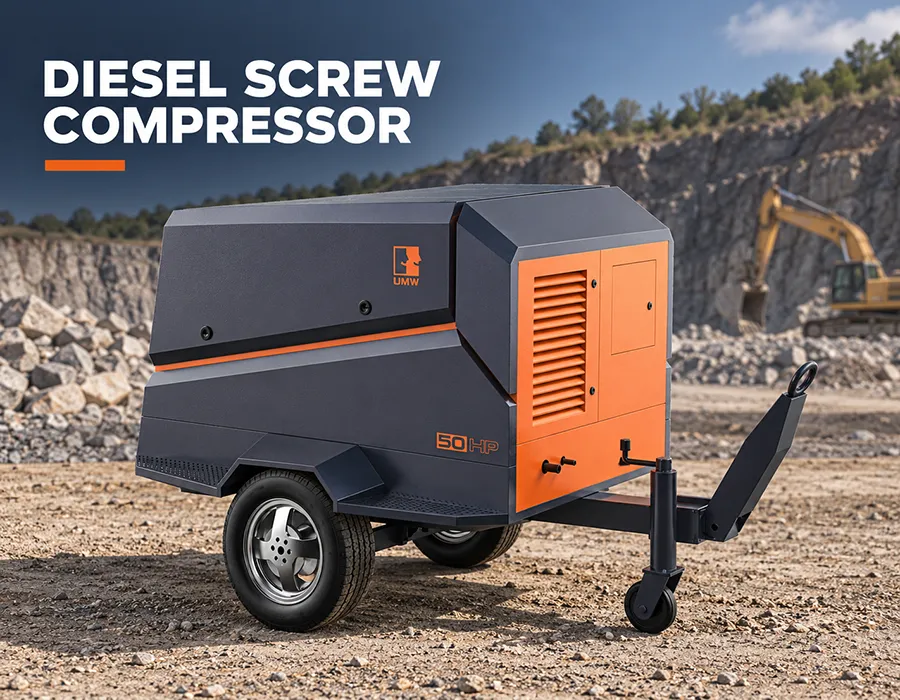
>UMW Air diesel compressors feature a compact design that facilitates easy transport, towing, and on-site positioning, allowing them to quickly relocate between projects. Whether at temporary construction sites or in space-constrained work areas, they can be put into operation rapidly, minimizing downtime and boosting construction efficiency.
3.2 Stable operation under demanding conditions
Outdoor construction environments often involve challenges such as dust, high temperatures, and vibration, placing higher demands on equipment reliability.
>UMW Air diesel compressors ensure stable compressed air output through efficient compression systems, reliable diesel power, and optimized air filtration designs. This enables the equipment to adapt effectively to complex environments and ensures the smooth progress of projects.
3.3 Reduced equipment management and maintenance burden
Compared to stationary units, mobile operations prioritize deployment efficiency and on-site adaptability.
UMW Air mobile compressors are simple and easy to operate. Their structural layout is logical and efficient, with key maintenance points easily accessible. This streamlines routine servicing and troubleshooting, effectively reducing downtime and maintenance costs while ensuring stable, high-performance operation and significantly increasing equipment availability and productivity.
3.4 Diverse configurations to meet varied needs
A wide range of optional configurations is available, including wheeled, skid-mounted, and sled-mounted versions, as well as cold-start capabilities, after-coolers with moisture separation, support jockey wheels, heavy-duty fuel filtration, special pressure vessel certifications, spill-containment bases, spark arrestors, and more.
Various packaging options are also available to meet export shipping requirements and save customers on logistics costs.
4. In which industries are diesel-powered rotary screw compressors commonly used?
Thanks to their excellent mobility, stable air supply, and adaptability to complex environments…
UMW Air’s diesel-powered mobile compressors are widely used in road and municipal engineering, building construction, mining and quarrying, sandblasting, and various outdoor projects, providing reliable compressed air support on-site.

- Mining and quarrying
Suitable for rock drilling, blast-hole drilling, pneumatic tool operation, and equipment maintenance. Its independent power source and mobility make it suitable for remote mining areas.
- Construction and Infrastructure
Provides compressed air for breakers, pneumatic picks, shotcrete equipment, and other pneumatic tools.
- Road and Bridge Construction
Suitable for pavement breaking, drilling, cleaning, and road maintenance; can be rapidly relocated along the construction route.
- Water Well and Geological Drilling
Drilling operations typically require high airflow and pressure to drive drilling tools and clear debris from the borehole.
- Sandblasting and Surface Treatment
Continuous, stable compressed air enables sandblasting equipment to remove rust, old coatings, and contaminants from steel surfaces.
- Pipeline Maintenance
Used for pipeline cleaning, pressure testing, pneumatic tools, and on-site repairs; ideal for pipeline projects located far from fixed power sources.
5. UMW Air Compressor Specifications
Below are the specifications for UMW Air’s towable diesel air compressors; please contact us for further details.
| Specification | Parameters |
| Product Type | Towable Diesel Screw Air Compressor |
| Rated Engine Power | 37 kW / 50 HP |
| Rated Air Delivery | 6 m³/min |
| Rated Working Pressure | 8 bar |
| Cooling Method | Air-cooled |
| Fuel Tank Capacity | 100 L |
| Fuel Consumption | 8 L/h |
| Operating Time | 10+ Hours |
| Dimensions | 1800 × 1800 × 1650 mm |
| Operating Weight | 1,500 kg |
Summary
A diesel rotary screw compressor is an industrial unit powered by a diesel engine that continuously compresses air using twin-screw rotors. Selecting the right model based on specific air demand ensures adequate air supply while minimizing fuel consumption and long-term operating costs. For more product details, please check: Towable Diesel Air Compressor
FAQ
1. Do diesel rotary screw compressors require an external power supply?
No external grid connection is needed. The unit is driven by a diesel engine, though components such as the controller, starting system, and lighting are typically powered by an onboard battery.
2. How long can a diesel rotary screw compressor run continuously?
Continuous run time depends on fuel tank capacity, load factor, fuel consumption, and environmental conditions. The unit should be shut down for refueling, inspections, and maintenance in accordance with the manufacturer’s requirements.
3. Are diesel rotary screw compressors suitable for sandblasting?
Yes, but the unit must be selected to provide sufficient airflow (FAD) based on nozzle size, quantity, and operating pressure, and configured with moisture separation and air treatment equipment to meet process requirements.
4. Can diesel rotary screw compressors be used at high altitudes?
Yes, but high altitude reduces air density, which can affect engine output and actual air delivery. Altitude correction factors must be applied during equipment selection.