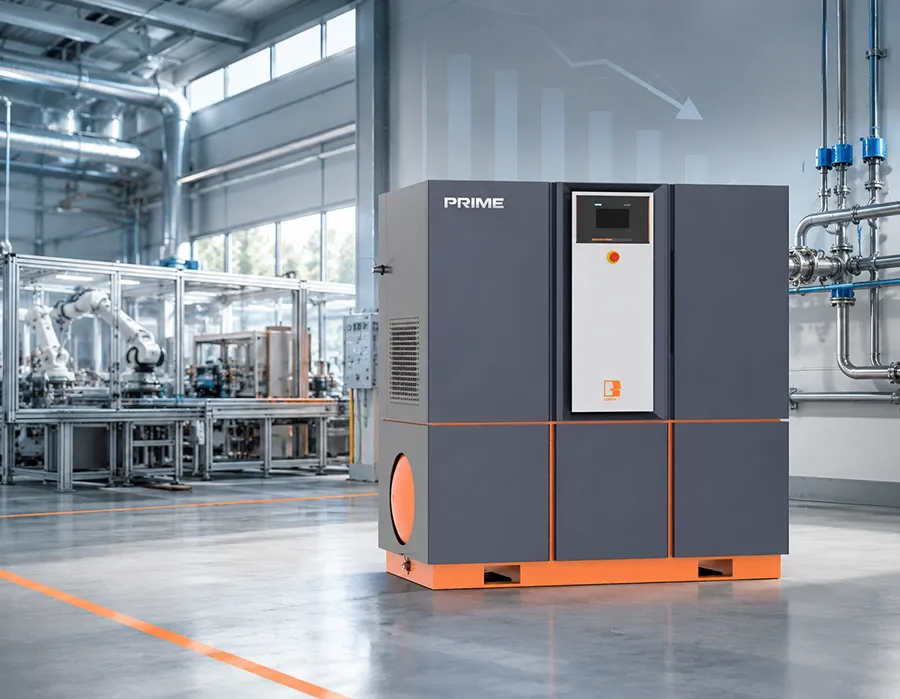
Recently, industrial gas market prices have fluctuated significantly. According to People’s Finance, argon prices have risen by over 240% since May, a devastating blow to some industrial sectors. These gas price changes serve as a reminder to manufacturing companies that if production is heavily reliant on external gas supplies, changes in price, transportation, and supply can impact production costs and delivery schedules. Therefore, configuring their own twin screw compressors becomes particularly important.
1. What is a Twin Screw Compressor?
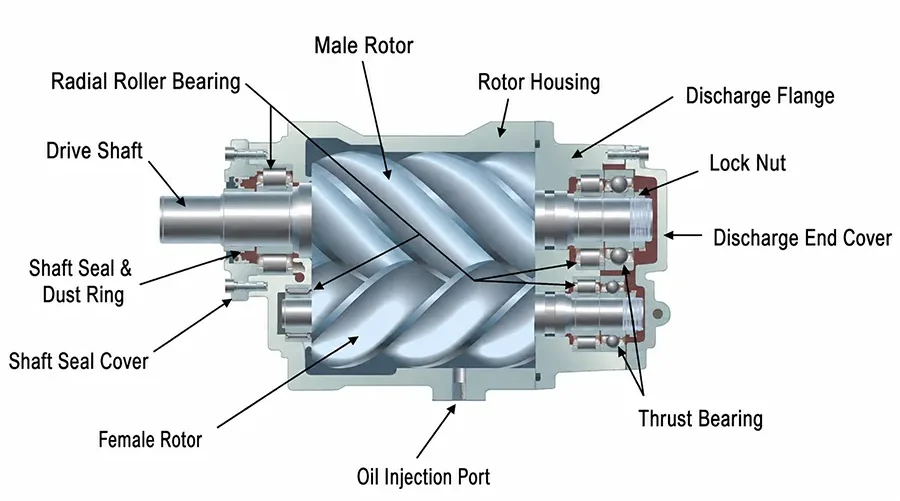
The term “screw compressor” usually refers to a twin screw compressor. Within the compressor body, a pair of meshing helical rotors are arranged in parallel.
A rotor with convex teeth on its outer pitch circle serves as the male rotor, while a rotor with concave teeth on its inner pitch circle serves as the female rotor. The prime mover usually drives the male rotor, which then drives the female rotor. The male rotor is the driving rotor, and the female rotor is the driven rotor.
Compared to single-stage compression, two-stage compression adds an additional set of male and female screws. The two sets of screws are connected in series, and the intake air is compressed stage by stage before being discharged. For more information, please see: What is a Screw Air Compressor?
2. Why Do Companies Need to Produce Their Own Compressed Air?
Purchased gases such as nitrogen and argon are subject to price fluctuations, making it difficult for companies to fully control their final gas costs.
By contrast, the operating costs of twin-screw air compressors are generally predictable and mainly depend on power consumption, operating hours, local electricity rates, and maintenance needs. Companies can estimate their monthly or annual compressed air costs.
More importantly, companies do not need to wait for suppliers to deliver compressed air. As long as the air compressor system, power supply, and piping remain operational, the factory can maintain a continuous air supply according to its production schedule.
3. Application Case: Upgrading the Air Supply System in an Automated Components Factory
A US-based automated components factory specializing in metal components has multiple automated production lines in its workshop. Compressed air is primarily used for cylinder operation, workpiece clamping, robotic arm and equipment purging, and some inspection stations.
With increasing order volumes, the factory added several more production lines. The original air compressor’s supply capacity gradually became insufficient to meet demand, especially when multiple workstations were operating simultaneously, frequently resulting in pressure drops at the end of the workshop.
The Main Problems Faced by the Factory:
- Insufficient pressure during peak hours;
- Frequent loading and unloading of the air compressor;
- Mutual interference between different production lines;
- Condensation at the end of pipelines;
- Increased energy consumption without a corresponding increase in effective air supply;
- The need for some production lines to stop operating if existing equipment is shut down.
Air consumption testing shows that the factory’s normal operating pressure is approximately 8 bar, with an average air consumption of approximately 2.4 m³/min and a peak air consumption approaching 3.2 m³/min. The production lines operate two shifts daily, for a total operating time of approximately 16 hours, and air consumption fluctuates with equipment start-up and shutdown.
4. Twin Screw Compressor System Configuration Solution
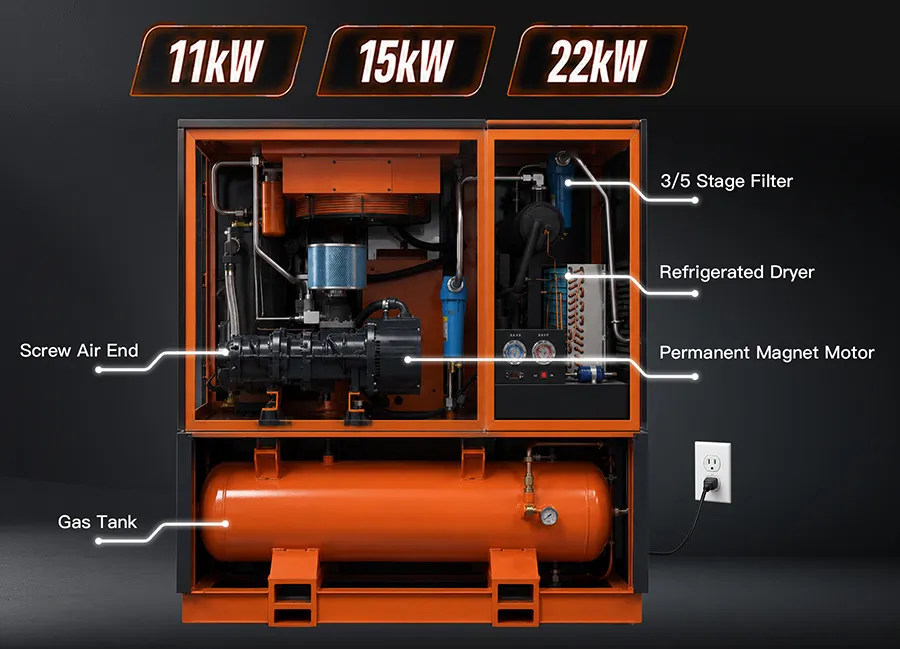
Based on the factory’s average air consumption and daily peak demand, UMWAir provided a Prime 22 kW integrated air compressor solution. This equipment integrates the twin-screw compressor, 340L air tank, refrigerated dryer, precision filter, and automatic drainage system into a single unit, directly providing stable, clean, and dry compressed air to the production lines. Functions of Each Integrated Module:
4.1 22kW Variable Frequency Twin Screw Compressor
Adjusts compressed air output according to the actual air consumption of the production line. When air demand decreases, the equipment can reduce its operating frequency, reducing energy waste caused by frequent loading, unloading, and idling.
4.2 340L Air Tank
Stores a certain amount of compressed air to buffer the instantaneous air demand generated by the simultaneous movement of cylinders, clamps, and robotic arms, helping to stabilize the system.
Built-in Refrigerated Dryer: Cools and removes water from the compressed air, reducing the entry of condensate into pneumatic equipment and production pipelines, lowering the risk of valve corrosion, cylinder failure, and water accumulation at the end.
4.3 3/5-Stage Precision Filter
The high-precision filter further reduces moisture, oil mist, and solid particles in the compressed air, providing cleaner compressed air for automated production equipment. Specific filtration standards should be configured according to working pressure and process requirements.
4.4 Electronic Automatic Drainage System
Promptly drains condensate generated during system operation, reducing manual drainage tasks and preventing water accumulation in the air tank and post-treatment system.
5. Practical Improvements Resulting from the Upgrade
5.1 More Stable Pressure During Peak Air Usage
Twin screw compressors can be configured to meet both moderate and peak air consumption in a factory. The air tank buffers short-term high-flow demands, while the variable frequency air compressor adjusts its output based on pipeline pressure, reducing significant pressure drops when the production line is using air simultaneously.
Stable pressure helps ensure cylinder actuation speed, clamping effectiveness, and the operating cycle of automated equipment, reducing downtime or product quality issues caused by insufficient air pressure.
5.2 Greater Autonomy in Air Supply Scheduling
Factor can start or adjust the air compressor system according to production shifts, without waiting for external suppliers to deliver. For companies that must operate continuously or temporarily increase shifts, independent air supply reduces the impact of external delivery delays on production plans.
5.3 Convenient Operation and Maintenance
Operators do not require extensive professional training, enabling unattended operation.
5.4 Good Power Balance
Twin screw compressors have no unbalanced inertial forces, allowing for smooth high-speed operation and foundation-free operation. They are particularly suitable for use as mobile compressors, being small in size, lightweight, and requiring little floor space.
6. How to Choose a Suitable Twin Screw Air Compressor?
When selecting a twin-screw compressor, companies should not only compare power and purchase price but also focus on confirming the following parameters:
6.1 Discharge Capacity
Discharge capacity is the “core capacity” of a screw compressor, referring to the amount of compressed air the equipment can output per unit time. We often fall into the misconception that “larger is better” regarding discharge capacity, neglecting the increased energy costs.
When an air compressor operates below its optimal operating range, its specific power increases sharply, leading to a significant increase in power consumption. For example, a compressor with a discharge capacity of 10 m³/min may only require an actual production capacity of 6 m³/min. The equipment is in a “discharged” state for extended periods, with a load rate of only 60%. Calculations show that under these conditions, the extra electricity costs alone can reach tens of thousands of yuan per year.
6.2 Discharge Pressure
This refers to the pressure of the gas output by the compressor. Many users believe that “higher pressure is always better” and choose a pressure level higher than their actual needs. Data shows that for every 1 bar increase in air compressor pressure, energy consumption increases by approximately 7%-10%, resulting in tens of thousands of yuan in extra electricity costs annually. More problematic is that excessively high pressure accelerates the aging of pneumatic components, leading to increased equipment maintenance costs.
6.3 Specific Power
Specific power is a core indicator for measuring the energy consumption of screw compressors, referring to the power consumed by the compressor to output 1 m³/min of compressed air. Compared to air volume and pressure, this data is relatively abstract and therefore often overlooked.
However, with the national call for energy conservation and emission reduction, energy efficiency ratings are increasingly becoming a core parameter for air compressor selection. The lower the specific power, the more energy-efficient the compressor, and the long-term savings may far exceed the price difference of the equipment.
6.4 Maintenance and Service
Purchase cost is only part of the equipment’s total life-cycle cost. Consumable supply, ease of maintenance, remote monitoring, fault response, and backup equipment solutions should also be considered.
Conclusion
The significant fluctuations in industrial gas prices indicate that when developing gas supply systems, companies should not only focus on current purchase prices but also consider supply stability, transportation conditions, and long-term production risks.
A properly configured twin screw compressor system is not just a single air compressor, but rather a combination of the compressor, storage tank, dryer, filter, piping, and control system. Only by selecting systems based on the company’s actual gas consumption needs can a balance be achieved between effective production, energy consumption control, and support for future capacity expansion.
FAQ
1. How long can a twin screw compressor last?
Under proper selection, standardized operation, and regular maintenance, industrial twin-screw air compressors can generally last for many years. The actual lifespan depends on operating time, ambient temperature, maintenance quality, and equipment load.
2. Where should the air compressor be installed?
It is recommended to choose a well-ventilated, clean, dry location that is easy to maintain. Sufficient space should be provided around it for heat dissipation and maintenance, and it should be kept away from high temperatures, dust, and corrosive gases.
3. Where are there leaks in the compressed air system?
The rate of pressure drop in the pipeline can be monitored during shutdowns. Ultrasonic leak detectors can also be used to check joints, valves, and hoses. Regularly addressing leaks helps reduce wasted energy consumption.